

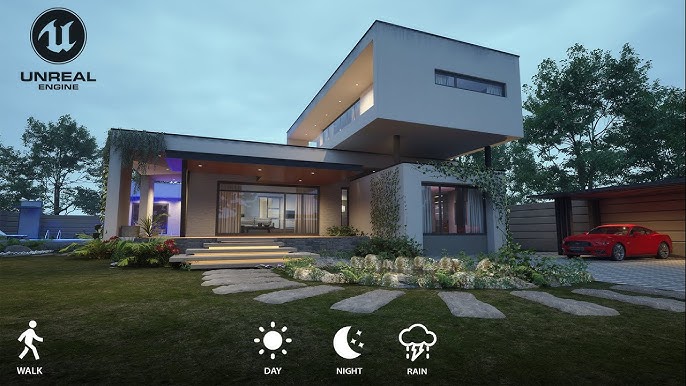
Architectural design has always been a dialogue between imagination and reality. For decades, architects translated ideas into drawings, plans, and static renderings, hoping clients could picture the finished building in their minds. But no matter how detailed the plans or beautifully rendered the images, there has always been a gap, one that can lead to miscommunication, unexpected changes, and costly revisions during construction.
At Imaraé, we believe that the best design decisions are informed decisions. And in today’s digital age, experiencing architecture in real time is the key to bridging that gap. Real-time visualization allows clients to step inside a building, even before the first brick is laid, and interact with the space in ways that traditional renderings or drawings simply cannot replicate.
Here’s why experiencing architecture in real time fundamentally changes the way clients make design decisions.
1. From Imagination to Experience
For most people, imagining a building from a two-dimensional drawing is challenging. Even skilled professionals can struggle to fully understand scale, light, and spatial relationships on paper.
Real-time visualization solves this problem by turning abstract plans into immersive, interactive environments, where clients can:
- Walk through rooms and corridors,
- Understand the flow between spaces,
- Feel the scale and proportions of interiors,
- See how light and shadows change throughout the day.
Suddenly, decisions about layout, materials, and finishes become experience-based, not hypothetical. When clients can truly “walk” through their project before it exists, they gain a deeper understanding of what they are approving, and the confidence to make choices quickly.
2. Faster, Smarter Decisions
When design is only presented through drawings or static images, clients often need multiple rounds of clarification. Questions like “Will this space feel too small?” or “Is this lighting going to work?” are difficult to answer without a lived experience of the design.
Real-time visualization transforms the feedback process into an interactive, collaborative session, where:
- Options can be explored instantly, swapping materials, adjusting furniture, or testing lighting scenarios,
- Decisions are grounded in observation rather than imagination,
- Revisions happen before construction, saving both time and money.
At Imaraé, this means fewer late-stage changes, less confusion, and a faster path from concept to construction.
3. Empowering Clients Through Interactivity
The beauty of real-time architectural experience is that it is not passive. Clients are no longer limited to reacting to static images, they can engage with the design directly.
They can:
- Explore multiple design options in the same space,
- Compare finishes, colors, and textures in real time,
- Understand circulation, accessibility, and ergonomics firsthand,
- Make confident decisions about lighting, materials, and layout.
This interactivity ensures that client feedback is meaningful, actionable, and grounded in reality, rather than guesswork or interpretation.
4. Bridging the Gap Between Architects, Engineers, and Builders
Architecture is rarely created in isolation. Real-time visualization also improves collaboration across all project stakeholders, as engineers, consultants, and builders can use immersive models to:
- Visualize systems and structural elements in context,
- Anticipate potential coordination challenges before construction,
- Review assemblies and workflows with clarity.
By creating a shared language of experience, everyone involved can align on the same vision, reducing miscommunication and errors down the line.
5. From Revit to Real-Time: Technology That Works
At Imaraé, our process begins in Autodesk Revit, ensuring precision, constructability, and accurate documentation. But Revit models alone, while technically robust, cannot communicate experience. That’s where Unreal Engine 5.7 comes in.
By importing our BIM models into Unreal Engine, we create photorealistic, interactive environments where clients can explore:
- Every detail, from material finishes to furniture placement, is preserved,
- Lighting, shadows, and environmental effects are fully dynamic,
- Design alternatives are easy to test and compare in real time.
This seamless workflow ensures that what clients experience virtually is true to the final building, giving them confidence in every decision.
6. Building Confidence and Trust
Design is ultimately a human-centered process. Clients who can experience architecture firsthand feel more engaged, more informed, and more confident.
This confidence leads to:
- Fewer misunderstandings or last-minute changes,
- A smoother approval process,
- Stronger trust between clients, architects, and contractors.
For Imaraé, it is not just about creating beautiful designs, it’s about creating clarity, certainty, and alignment from day one.
7. The Future of Design Is Experiential
The days of relying solely on drawings and static renderings are ending. As technology evolves, real-time architectural experiences will become the standard, not the exception.
Clients will expect to step inside their projects virtually, engineers will expect to see systems in context, and builders will expect guidance that reduces ambiguity. At Imaraé, we are proud to be at the forefront of this transformation, using real-time visualization to empower every stakeholder to make better, faster, and more confident decisions.
Conclusion
Architecture is no longer just about drawings and renderings, it’s about experience. When clients can walk through a space before it exists, explore options interactively, and collaborate in real time, design decisions become smarter, faster, and more aligned with vision.
At Imaraé, we believe that this experiential approach isn’t just a tool, it’s a fundamental shift in how architecture is created, shared, and understood. And for our clients, that means one thing above all, clarity, confidence, and a design process that truly feels like a collaboration.
Author – Jenna Van Wyk
Jan of 2026

Leave a Reply